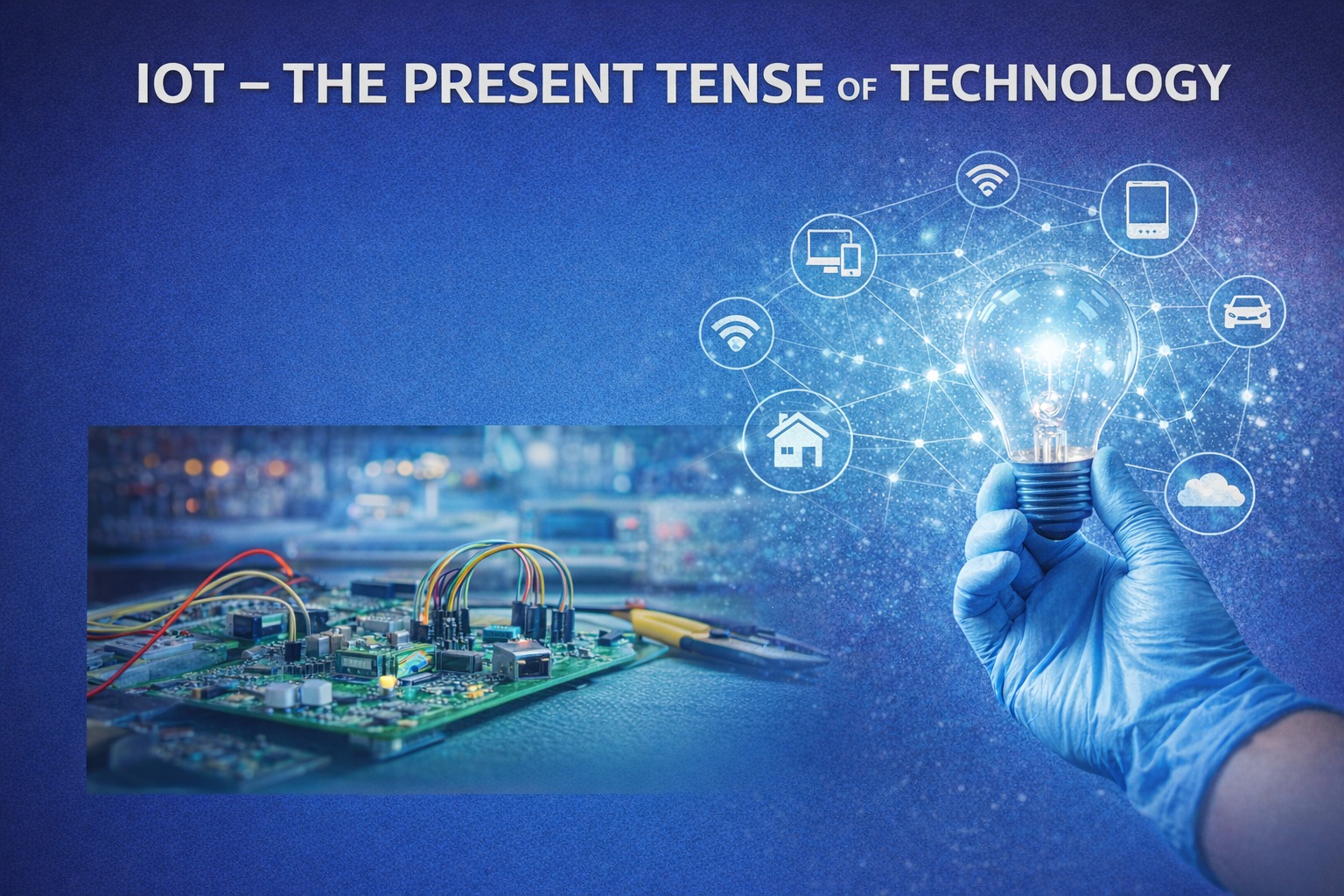
An Embedded System buzzing word in today’s Artificial intelligence and machine learning era. It is a combination of hardware and software designed to perform a dedicated function inside a larger device.Unlike general-purpose computers, embedded systems are task-specific, optimized for performance, cost, and reliability.
Embedded systems are not limited to a single industry; they can be found in nearly every sector.
The embedded domain is evolving faster than ever. Here are the major trends shaping the industry.
- Internet of Things (IoT) & Edge Computing
- AI & Machine Learning on Embedded Devices
- Automotive & EV Electronics
- Real-Time & Safety-Critical Systems
- Low-Power & Energy-Efficient Designs

Understanding the mechanics of this system is crucial, and developing expertise in it can help anyone land lucrative job opportunities.
Below are the approaches that can be utilized to develop expertise in embedded systems and excel in emerging technologies.
✔ 1. Strong Foundation in Electronics
Understand:
- Basic circuits & components
- Sensors and interfacing
- Power supply & regulators
- Signal conditioning
Why it matters:
Expert embedded engineers design systems that are both functionally correct and hardware-friendly.
✔ 2. Microcontrollers & Architecture
Learn popular families:
- AVR (ATmega)
- ARM Cortex-M
- ESP32
- STM32
- PIC
Concepts to master:
- GPIO, Timers, Interrupts
- ADC, PWM
- Communication protocols (UART, SPI, I2C, CAN)
Methodology:
Start with development boards, then move toward bare-metal programming.
✔ 3. Embedded C & C++ Programming
This is the backbone of firmware development.
Focus on:
- Pointers & memory management
- Bitwise operations
- Structures & unions
- Interrupt-driven programming
- Low-level register access
Short Tip:
Write clean, modular, and efficient code — performance matters in embedded devices.
✔ 4. Real-Time Operating Systems (RTOS)
Used when systems need multitasking & precise timing.
Learn concepts like:
- Tasks & scheduling
- Synchronization
- Queues & semaphores
- Interrupt handling
Popular RTOS options:
- FreeRTOS
- Zephyr
- RTX
Methodology: Start with simple multitasking projects like sensor + display + communication handling.
✔ 5. Embedded Communication Protocols
Essential for device-to-device communication:
- UART / USART
- SPI
- I2C
- CAN
- USB
- BLE / Wi-Fi / MQTT (for IoT)
Short Tip:
Analyze signals using logic analyzers or oscilloscopes to truly understand protocol behavior.
✔ 6. Debugging & Testing Skills
An expert embedded engineer is a great debugger.
Learn tools:
- JTAG / SWD Debugging
- Oscilloscope
- Logic analyzer
- Serial monitor tracing
Focus on:
- Memory faults
- Timing bugs
- Interrupt anomalies
Methodology:
Use systematic debugging — reproduce, isolate, analyze, and fix.
✔ 7. Embedded Linux (Advanced Level)
Important for applications like:
- Gateways
- Industrial systems
- AI-edge devices
Topics to explore:
- Linux kernel basics
- Device drivers
- Yocto / Buildroot
- Shell scripting
Short Tip:
Start with Raspberry Pi → move to ARM-based Linux boards.
✔ 8. Project-Based Learning & Hands-On Practice
Projects help convert knowledge into expertise.
Beginner ideas:
- Temperature logging system
- Line-following robot
- Smart switch with mobile control
Intermediate projects:
- IoT home automation
- Data logger with SD card
- Wearable health band prototype
Advanced projects:
- RTOS-based automation system
- Edge AI gesture recognition
- Automotive CAN-bus controller
Methodology:
Document projects, test thoroughly, and iterate — that’s how real engineers grow.
Conclusion
Becoming an expert in Embedded Systems is a journey that blends:
- Electronics foundation
- Strong programming skills
- Real-time system understanding
- Debugging and optimization experience
With industries moving toward IoT, AI, Automation, and Smart Devices, embedded engineers have limitless opportunities.
The key is consistent learning, hands-on practice, and building real-world projects.